Launch of a new DRESDEN-concept Research Group at the German Centre for Astrophysics and Dresden University of Technology
02.04.2026
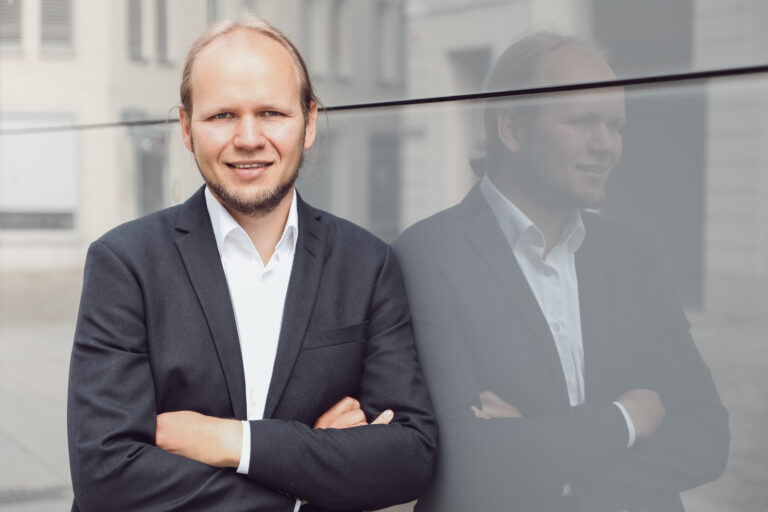 © Johannes Benduhn
Dr Johannes Benduhn is strengthening Saxony’s research landscape through his work on novel photodetectors for astrophysical applications.
From April 2026, a new DRESDEN-concept Research Group will be launched under the leadership of Dr Johannes Benduhn at the German Centre for Astrophysics (DZA) and at Dresden University of Technology (TUD). The research group, entitled “Scientific organic photodetectors (SCOPE)”, is a joint initiative of the DZA and the Institute of Applied Physics at TUD. The aim is to further intensify cooperation between the two institutions in the field of innovative detector technologies and to expand their international profile.
SCOPE’s research focuses on novel photon-sensitive devices based on innovative semiconductor materials. These are being specifically developed for applications in astrophysics, which place particularly high demands on sensitivity, low noise and spectral precision. A particular focus is on analysing and optimising the performance of such systems under conditions of very low light intensity and low temperatures.
The research group builds on extensive groundwork carried out at the Institute of Applied Physics, where Dr Benduhn already heads the ‘Organic Sensors and Solar Cells’ research group. The research priorities there include, amongst other things, organic semiconductors, nanoparticle materials and novel component architectures for highly sensitive and spectrally selective photodetection.
With the new DRESDEN-concept Research Group, this expertise is being specifically applied to issues relating to astrophysical instrumentation. The close integration of basic research and technological development creates essential conditions for the realisation of future generations of high-performance image sensors, such as those used in astronomical observation and space-based measurement systems.
The establishment of joint research groups is a key component in the further development of the DRESDEN-concept Alliance. It promotes cross-institutional collaboration and strengthens Dresden’s position as an internationally recognised centre of science.
The new position also offers ideal conditions for Dr Benduhn: since October 2024, he has been setting up a working group for detector research at the DZA and, through his parallel affiliation with TU Dresden, acts as a bridge between the two institutions. The DRESDEN-concept Research Group will further deepen this cooperation and strategically expand it through the targeted involvement of additional partners.
In addition to academic excellence, the project also aims to provide a lasting impetus for regional structural change, for example through the training of highly qualified specialists, the development of modern research infrastructure, and raising the international profile of Lusatia as a hub for cutting-edge technology.